
Graham Forest Provides Watershed Protection and an Oasis for Wildlife

Eastern hemlock has re-seeded and matured on the property.
We all know change is inevitable, and nowhere is this more visible than the landscapes around us. Land is cleared for agriculture or developed for housing, and natural resources are removed and extracted. But sometimes people find special land and spend a lifetime appreciating its natural features. Working with a land trust to protect property with a conservation easement is one way to ensure these resources remain intact for future generations.
Nancy Graham grew up in urban Milwaukee and attended college at UW-Madison. She felt called to move her life northward as a young adult in the 1970s and visited a friend who had gone completely off-grid near Mellen. Watching her friend washing diapers in a kettle over an open fire gave Nancy a healthy dose of caution, however. “I rethought my desire to move my whole life north at that point,” she said.
In 1974, she purchased 80 acres of mostly forested land 15 miles south of the City of Ashland. Together with her young children and a friend who had some carpentry skills, they spent the weekends over two summers rebuilding a cabin they moved to the property from a farm west of Amery, Wisconsin. The hefty tamarack logs had been marked with Roman numerals in the style typical of a dwelling built by Swedish settlers in the 1850s.

Nancy Graham and Gary Gehrman

Nancy and her children rebuilt a cabin on the property in the 1970s.
Several decades later, Nancy continues to enjoy visiting the property in all seasons, though she commented that her partner Gary is a bit hardier when it comes to the winter months. They observe and appreciate wildlife on the property including coyote, wolves, bobcat, porcupine, pine martens, barred and great gray owls — “pretty much everything but a fox snake,” Gary said. Nancy has seen signs of bear over the years and recalls seeing vapor rise from a den on a cold day.
Over the years, the property has not remained static – eastern hemlock has reseeded and matured, the wild turkey population has increased, and some of the larger aspen trees fell during a severe windstorm a few years ago. The ravines that drain the property northward into the Marengo River have deepened due to erosion from heavier and more frequent rains. But overall, change comes slowly, naturally, and unpredictably, which is Nancy’s vision for the property. As land use changes in the surrounding area, “the property is an oasis for anything that needs it – a small way to give back to the planet,” she stated.

The historic cabin was first built by Swedish settlers.
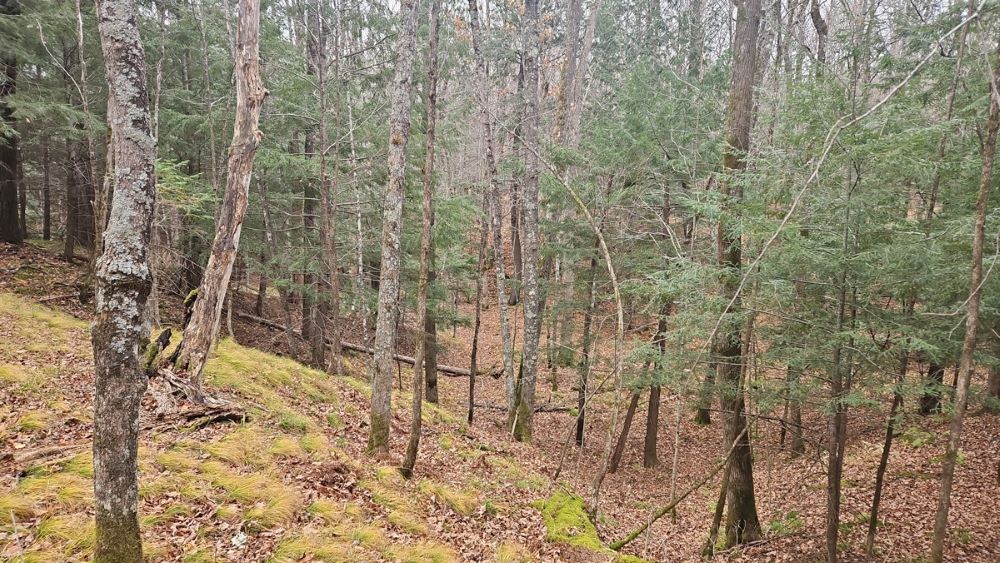
Ravines drain the land northward into the Marengo River.
“People often intensively manage land for food or fiber,” said Executive Director Rick Remington. “It’s good to have places that aren’t heavily managed, to see what nature will do when you leave her alone.”
With funding from a grant through the U.S. Fish and Wildlife Service’s Coastal Program, Landmark Conservancy Conservation Manager Erika Lang worked with Nancy and Gary to develop a plan to protect the natural resource values of the land through a conservation easement, a document that will remain with the title of the property forever.
Landmark commits to monitor the property annually in perpetuity as part of the organization’s portfolio of protected land, which includes 228 conservation easements and over 44,000 acres.
“In addition to providing habitat for a vast array of species, the Graham Forest is in the Marengo River watershed which is a tributary to the Bad River on its way to Lake Superior,” Lang added. “By maintaining this property’s forest cover which in turn helps ‘slow the flow’ of water across the landscape, we are complementing the work that natural resource partners have laid out in the Marengo River Watershed Action Plan.”
Thank you Nancy for caring and preserving your piece of heaven.
Preserving habitat and history. Thank you.
Another notch in the Marengo River Watershed Action Plan! Excellent work. Thank you.
What a beautiful piece of land you have protected. Good job and thanks to all the concervers such as you!
Congratulations nancy for protecting your acreage and putting your faith behind Landmark to keep it preserved.
What a wonderful uncomplicated way to save the environment!
An unselfish action to improve your life specifically, and everyone’s environment and quality of life generally. Thank you!
Wonderful that you are letting the woods just be! It will be a joy to watch natural processes over the years to come. Particularly the maturing of the graceful hemlocks.